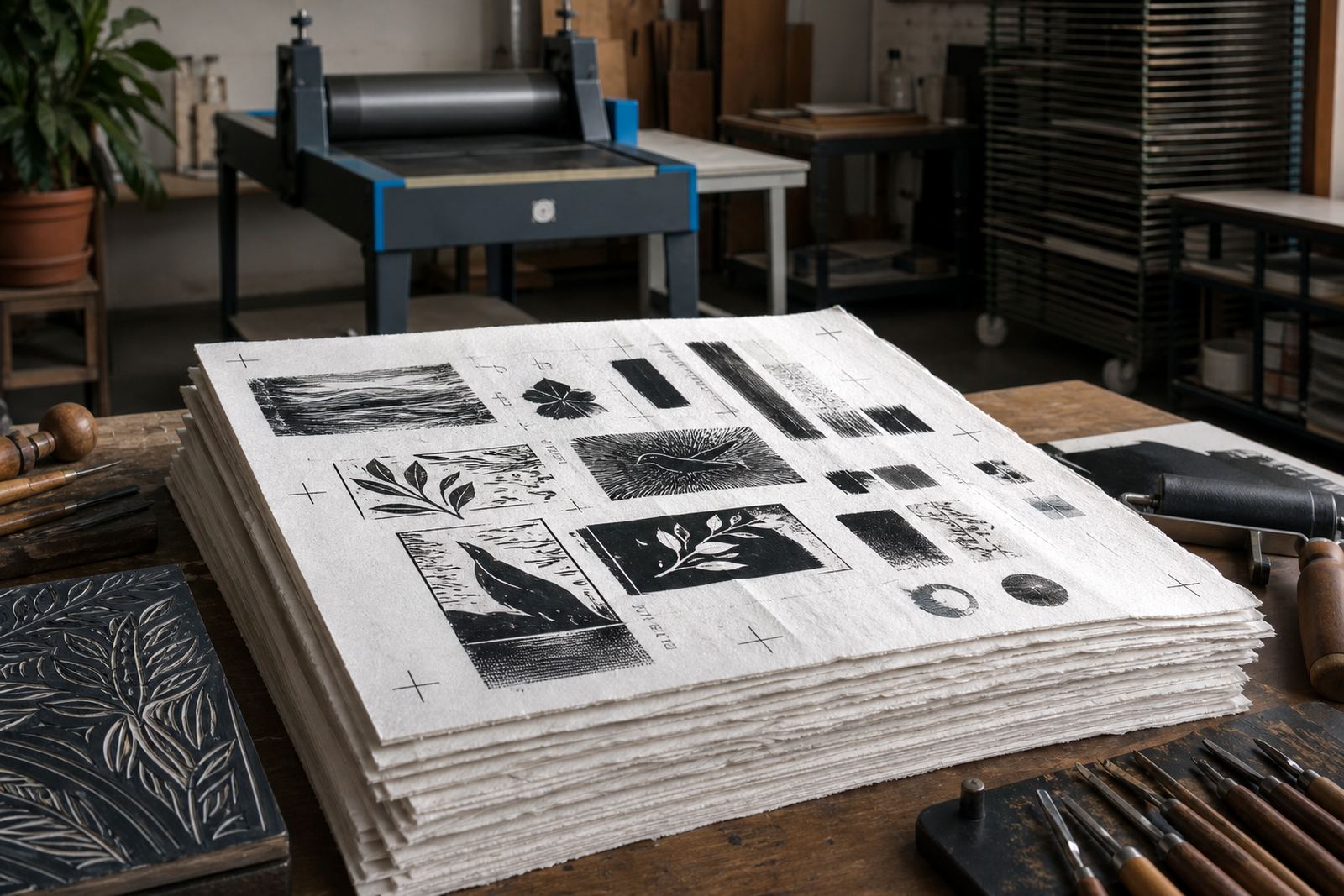
Paper for the messy middle of a print run
This pack is the paper you reach for before the proper edition sheets. It suits first carvings, colour trials, pressure tests and small registration checks where you need to see how the block is behaving under a brayer, baren or press. The sheets are made for hand printing, so they take water-based and oil-based block inks in a sensible way and let you judge a pull before you move to your final paper.
It is a practical choice for workshops in Woodstock, student studios, school pop-up sessions and home carving tables where people are learning how much ink to load, how firm the pressure should be and whether the carved areas are clearing cleanly. When a design has tight lines, shallow cuts or repeated shapes, test sheets show it early.
- For proofing a first block before edition paper is used
- For colour studies with one block or several layers
- For checking carved marks, edges and ink coverage
- For practice pulls with baren, hand burnishing or press printing
Sheet sizes and pack options that suit printmaking work
The pack is usually supplied in manageable sheet counts for workshop use, with sizes chosen to match common linocut and block-print formats. Smaller sheets work well for carving drills and quick tests, while larger sheets suit full image proofs, split-colour layouts and edition planning. If your block is larger than the sheet, the paper can still be trimmed after printing, but it is better to match the paper to the image area before you start.
For relief printing, the sheet needs enough surface strength to take repeated handling, lifting and drying. That matters when you are testing multiple passes or a block with a fine V-tool line that can fill up fast if the paper moves around. If the workshop uses a press, the paper should feed cleanly and sit flat without buckling in the cylinder path or under blankets.
- Available in common workshop sizes for relief printing
- Suitable for single-sheet tests and small edition planning
- Can be used for hand burnishing or press-fed pulls
- Works for one-colour and multi-block registration trials
Where this paper earns its keep in the studio
This pack is useful anywhere people are learning the rhythm of lino and soft-cut work. Adults use it for edition planning, students use it for class exercises, families use it for simple carved images and team groups use it for shared print tasks where everyone wants to see a finished pull before the final run. It is also a steady choice for teacher workshops and venue setups where several people need the same paper without mixing in final stock.
Because linocut can shift from neat line work to heavy texture very quickly, a practice sheet gives you room to test each stage. You can see whether the gouge marks are deep enough, whether the ink sits too dry, whether the paper is taking the impression evenly and whether the registration marks line up after the second pass. That saves time when the real edition starts.
- Useful for beginner carving sessions and open studio work
- Handy for schools where class sets need consistent paper
- Good for team sessions with layered colour and repeat pulls
- Suitable for venue-based workshops and studio demonstrations
How the sheets behave with carve, ink and pressure
In linocut and block printing, the paper needs to accept both soft hand pressure and the stronger bite of a press. The Practice Paper Pack is selected to hold a clean image without giving a false result. If the ink is too wet, the surface will show it. If the pressure is too light, the paper will tell you. That is exactly what practice paper should do.
With water-based block inks, the sheet gives a clear read on drying speed and line clarity. With oil-based inks, it helps you check how much impression the surface can take before details start to blur. If you are using a baren, the sheet shows whether your pressure is even across the block. If you are using a press, it helps you confirm the packing and blanket feel before the final stock goes through.
- Shows line detail, pressure marks and plate cleanliness
- Useful for registration marks and layered colour checks
- Helps compare hand-burnished pulls with press pulls
- Lets you test ink tack, coverage and drying behaviour
Handling, storage and keeping test sheets usable
Paper for proofing should stay flat, dry and free of dust. Store the pack in a cool, dry place, away from damp air and direct sun, especially in coastal conditions where paper can pick up moisture quickly. Keep the sheets in their wrapping until you need them, then move them with clean hands so the surface stays ready for a fair test pull.
If the sheets are used for repeated demonstrations, keep the remaining stock under weight so it does not curl at the edges. For studio work in Cape Town and other humid towns, keep the stack tidy and flat. A bent sheet can change the way ink transfers and makes a print look worse than the block actually is.
- Store flat to avoid curl and surface marks
- Keep away from damp air and dusty benches
- Use clean, dry hands when separating sheets
- Re-stack unused paper under a weight after opening
What to confirm before ordering
When ordering a Practice Paper Pack, confirm the sheet size, the paper count, the surface finish and whether the work will be done by hand or on a press. If the pack is for school classes or a group booking, it helps to know how many people are printing at once and whether the block size changes from one session to the next. A smaller proofing sheet can save paper on rough tests, while a larger one may suit full image planning better.
It also helps to confirm the kind of ink in use, the expected edition size and whether the paper must sit through more than one layer. If your studio uses registration guides, say so at the start so the paper format matches the layout. For workshop packs, it is worth noting if the sheets will be cut down later or used as received, because that changes how the stock is packed and handled.
- Sheet size and whether trim allowance is needed
- Paper count for the number of pulls planned
- Hand printing or press printing method
- Ink type, registration needs and finishing use
Key facts
| Product type | Practice paper pack for linocut and block printing |
|---|---|
| Use | Proofing, test pulls, technique drills and registration checks |
| Suitable methods | Baren, hand burnishing and press printing |
| Ink compatibility | Water-based block inks and oil-based block inks |
| Common uses | Beginner work, student exercises, school sessions and edition planning |
| Pack details | Sheet size and count supplied to match workshop or studio needs |