
What sits in an edition packing set
An edition packing set brings the practical pieces together for drying, stacking and protecting fresh prints after inking and printing. It is used once the sheet has been pulled from the block, whether the impression came from a baren, a press or hand burnishing, and it helps keep each print flat while the edition settles.
The set usually centres on clean interleaving, stiff support boards and neat separators so the stack does not pick up dust, cockle or bruised corners. In a linocut or soft-cut edition, that matters from the first proof to the last print, especially when the paper has taken a heavy ink layer or a firm emboss from the block.
- Rigid boards under each stack
- Interleaving sheets for clean separation
- Corner protectors or edge guards for handled bundles
- Labels for edition counts, proof sets and date notes
Sizes and packing options for different editions
Edition packing sets can be matched to the paper size you print most often. Small workshop editions might sit neatly on A5 or A4 sheets, while student sessions and group work often use A3 or similar art papers that need wider boards and more breathing room between layers.
Options usually include light packing for short runs, firmer board packs for transport, and fuller studio packs for editions that will be stored, flattened and sorted over a few days. If you print on heavier cotton papers, handmade sheets or textured stock, a thicker support board helps hold the stack square and keeps the edges from curling.
- A4, A3 and custom board sizes for common print formats
- Light, medium or heavy packing density
- Paper-safe interleaves for dry or freshly inked prints
- Bundle ties or wrap sheets for moving finished editions
Where this pack earns its place in the studio
This product suits adults learning block printing, students building editions and workshop teams that need to sort prints at speed without mishandling them. It also fits school pop-up days, teacher training sessions and family print workshops where several hands are moving through the same drying area.
In a busy studio, an edition packing set keeps proof prints separate from the final run, which makes registration checks and edition notes easier to manage. It is also useful for venues in Woodstock, Stellenbosch, Johannesburg, Pretoria and Durban where work may need to be packed, carried and stored before the paper is fully settled.
- Studio teaching sessions with several edition stages
- School rooms where tables need clear sorting space
- Pop-up workshops at venues and festivals
- Short production runs with mixed paper weights
Handling, fitting and studio use
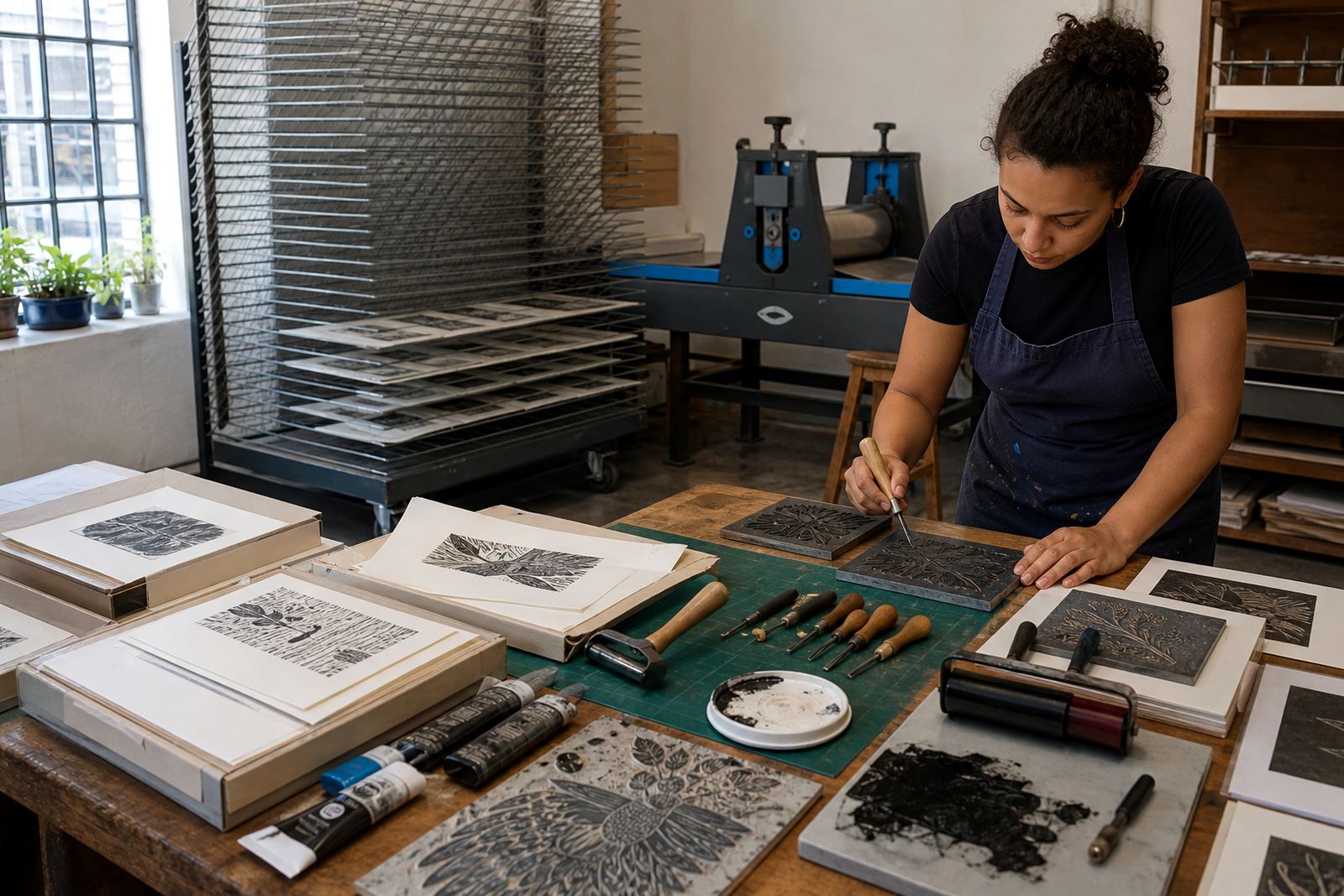
There is no fixed installation for this product, but it should be set up on a level surface with enough room for flat stacking and safe lifting. If you use a press table, drying rack or shelf unit, the pack needs to match the width, depth and load of that storage area so the boards sit flat and do not sag under a damp edition.
Freshly printed sheets should be moved by the edges and stacked with the correct interleave facing each print side. For oil-based inks, extra drying time may be needed before a tight bundle is closed. Water-based inks can dry faster, but they still need careful spacing so damp sheets do not transfer mark to mark.
- Level table, rack or shelf space for flat use
- Board width matched to the finished print size
- Room for edge clearance around the stack
- Enough cover sheet material for the full edition count
Care for boards, sheets and finished prints
Keep the packing materials clean, dry and away from damp corners or direct sun. In Cape Town and along the coast, humid air can slow drying and encourage paper curl, so the stack should stay in a dry room with good air flow rather than near open windows or a wet sink area.
Boards and interleaves should be checked for ink smears, dust and grit before each session. If a sheet picks up a mark, separate it from the clean stack at once. For editions that will be stored for weeks or moved between venues, a simple outer wrap or carton helps the prints stay square and keeps the corners from getting crushed.
- Use a dry cloth only on support boards
- Replace stained interleaves before the next edition
- Store flat, never leaned against a wall
- Keep finished prints away from moisture and grit
Before we pack the set
When you order an edition packing set, the useful details are the print size, the paper weight, the number of impressions in the edition and whether the prints will travel after drying. It also helps to note if the work is a single-colour block print, a reduction print or a multi-block piece, because that affects how much space the stack needs at each stage.
For workshops in Cape Town or pop-up teaching across South Africa, confirm the storage method too. A set for loose tabletop drying is different from one meant for a press room, a school art store or a boxed transport run. If you use a press, baren and hand burnishing in the same session, the packing mix should still keep proof sheets and final prints clearly apart.
- Finished print size and paper type
- Edition length and number of proof sheets
- Drying method: rack, shelf, board stack or carton
- Transport needs between studio, school or venue
Key facts
| Product type | Edition packing set for hand-pulled prints |
|---|---|
| Use case | Drying, stacking, separating and protecting editions after printing |
| Typical paper sizes | A4, A3 and custom board sizes |
| Compatible print methods | Linocut, soft-cut block print, press work and hand burnishing |
| Key materials | Support boards, interleaves, labels, edge protection and wrap sheets |
| Best suited to | Studio editions, workshops, school pop-ups and transport between venues |