
Flat storage beats clever stacking
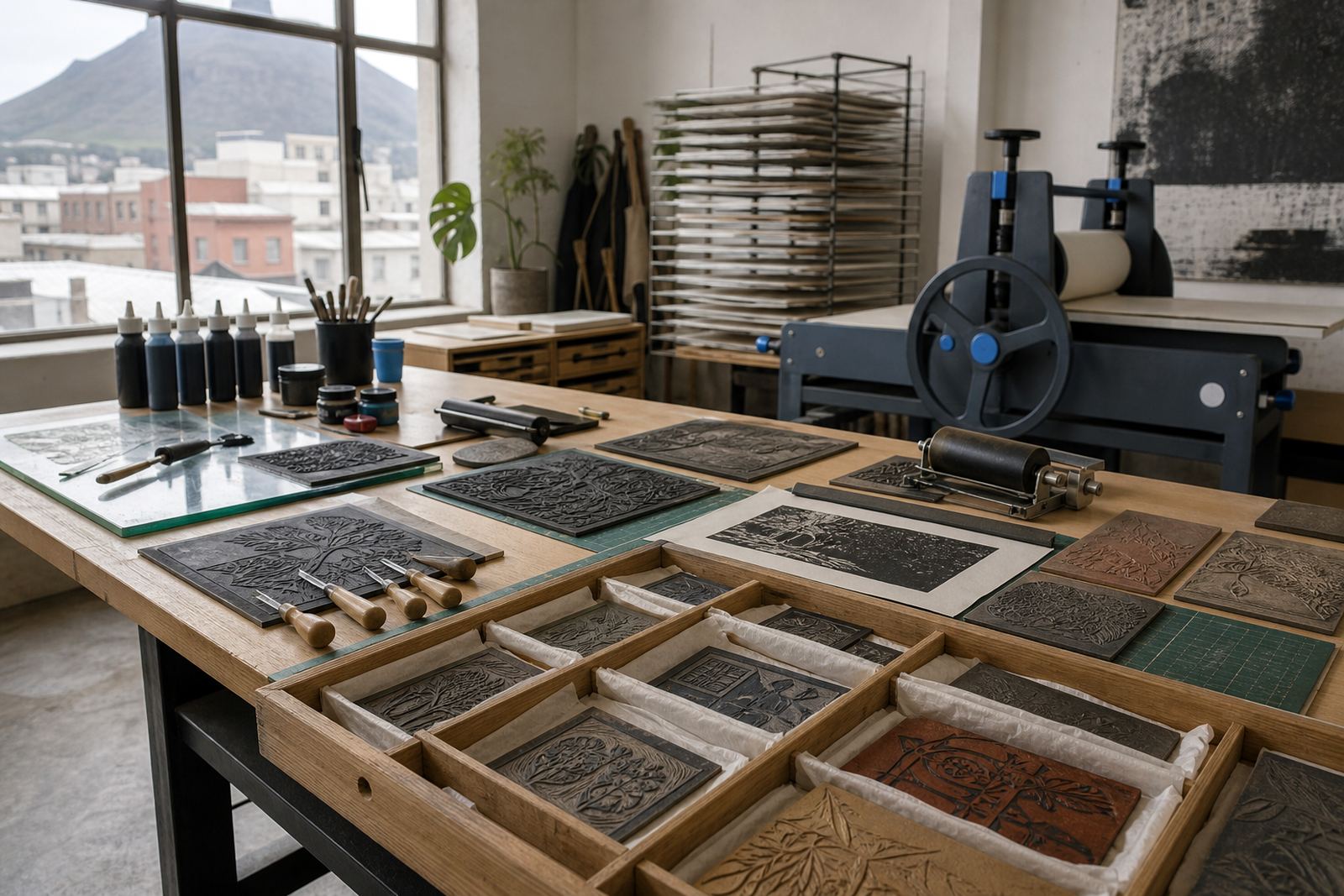
The easiest way to damage a carved block is to let it curl, bow, or press against a rough surface. Lino and soft-cut blocks should sit flat on a shelf, in a drawer, or inside a box that does not flex at the corners. If a block is left leaning against a wall in a warm room, it can pick up a bend that shows up on paper later.
For larger editions, keep each block supported from underneath. A thin sheet of board or acid-free paper behind the block helps stop grit from marking the carved face. In Woodstock studios, where humidity can rise after a damp morning or a coastal change in weather, flat storage matters even more because soft material shifts more easily.
Cleaning the block before it goes away
Ink left on a block will migrate into the cuts, stain the edges, and harden in the fine channels. Wipe the surface after printing with a soft rag and a little gentle cleaner suited to the ink type. Water-based block inks lift easily if they are dealt with before they dry. Oil-based inks need a steadier clean-up and a bit more patience, but the rule is the same: do not store a dirty block.
- Remove loose ink from the face first.
- Clean the raised areas without flooding the carved lines.
- Before you pack it away, make sure the block is fully dry.
- Keep paper scraps, tape and dust off the surface.
Any dampness trapped in a stack can leave marks on the next proof, especially if the block sits in a closed plastic box for too long.
How to protect carved lines and registration marks
Carved blocks are worth looking after. It carries edge marks, registration guides, and sometimes small notes made during the edition. Those details help when the block is used again for a fresh run or for future proofing. Do not rub the carved face with anything rough, and avoid placing heavy tools on top of it.
When blocks are stored for more than a short stretch, place a sheet of clean paper over the image side, then keep another rigid layer on top if needed. That extra layer stops gouges from catching on another block. If a block has registration marks close to the edge, protect those corners carefully because they guide paper placement on the press or when hand burnishing with a baren.
What works in a small Cape Town studio
A small print room in Woodstock or Bellville needs orderly storage. Label each block clearly, keep proof prints with the block, and store related papers in the same folder or box. That way, when a student group returns months later, or a family workshop wants to print the same image again, the setup is already sensible.
- Use shallow boxes rather than deep piles.
- Separate finished editions from test sheets.
- Keep blocks away from direct sun on a windowsill.
- Store soft-cut blocks away from sharp tools and loose metal ends.
In a humid coastal workshop, a little airflow is useful, but not so much that dust settles on the carved face. Keep carved blocks on a dry shelf, well off the floor.
Between proofing and the next edition
If a block is likely to be used again, keep a note with the paper type, ink mix, and registration setup. Those details save time when the image is printed a second time or matched with a new paper stock. A block that was made for a lighter Japanese paper may need a different pressure on the press if it is later used on a heavier cotton sheet.
Edition work rewards consistent handling. Store the first good print, the proof, and the block together so the sequence is easy to follow. That makes it simpler to check whether the pressure, inking, or carving depth needs adjusting before the next run. If a block has been used for a class, mark it clearly so no one mistakes a teaching block for a finished edition block.
A simple shelf routine for long-term care
A reliable routine is usually better than a special trick. Clean the block, dry it, place it flat, protect the surface, and keep it labelled. That is enough for most lino and soft-cut work, whether it is a first student print or a carefully pulled edition. For schools and team sessions, it also means the next group can pick up the process without guessing what happened before.
At HandPrinter Art, we keep the same discipline in studio sessions and pop-up classes across Cape Town, Stellenbosch, Johannesburg, Pretoria and Durban. A stored block should still feel ready for the next pull. If the carving is sound and the surface is kept clean, the block can serve another round of proofing without losing its edge.